
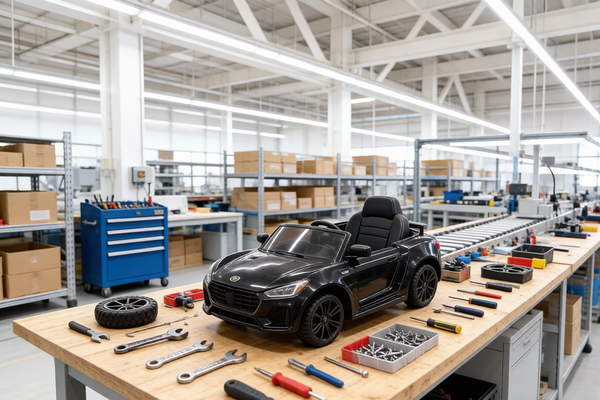
A factory audit for ride-on toys should answer a simple commercial question: can this supplier connect the company profile, the selected SKU, the production process and the shipping documents into one traceable order? A polished showroom or a broad product list is not enough. Importers, distributors, wholesalers and retail businesses need evidence that the factory can explain what it produces, how the configuration is controlled and who confirms the final shipment.
CT TOYS publishes factory information as a starting point for buyer research. The public Factory Facts page describes the verified company identity and operating information. The buyer should still confirm the current model, quantity, packaging and destination-market documents in writing before placing an order.
1. Confirm the legal and operating identity
Start with the company name, website domain, factory location and sales contact. The name used on a quotation, invoice, packing document and compliance file should be consistent. If different names appear, ask which entity signs the commercial transaction and which entity manufactures the selected product. This step prevents a buyer from comparing a factory profile with a quotation issued by an unrelated intermediary.
Record the official domain, email address and WhatsApp number. Check whether the contact person can answer model-level questions rather than only sending a generic catalogue. A direct answer should identify the SKU, voltage, battery option, carton data and current availability or clearly state that the information needs confirmation.
2. Link the factory to the exact SKU
Choose the actual products from the wholesale product range. Do not audit a factory using a screenshot of a product with no model code. Write down the SKU, product family, voltage, drive type, battery configuration, charger, remote-control option, colour and accessories. These details form the baseline for sample approval and later inspection.
Ask which production site or line handles the model, whether the configuration is standard or customised, and which parts may change between batches. A factory with several product families may use different production processes for cars, motorcycles, ATV/UTV vehicles and go-karts. The useful answer connects the selected model to the people and records responsible for it.
3. Review process and quality checkpoints
Ask how incoming components, assembly, function testing, appearance checks, charging tests and carton packing are recorded. You do not need a complicated factory manual to begin; you need a clear list of checkpoints and the person responsible for each one. Confirm how defects are handled, how replacement parts are identified and how a production question is escalated.
| Audit area | Evidence to request | Buyer decision |
|---|---|---|
| Identity | Legal entity, domain, address and sales contact | Can the supplier be matched across documents? |
| SKU control | Model code, configuration and approved sample | Is the quotation tied to one exact product? |
| Quality | Inspection points, test records and corrective process | Can the buyer define acceptance before loading? |
| Packaging | Carton dimensions, labels, manual and loading data | Can the warehouse receive the order as planned? |
| Compliance | Model-specific documents and market scope | Do the files cover the final configuration? |
4. Check documents by model and market
The Certification page explains why documents must be matched to the exact SKU, battery, charger, motor, labels and destination market. A certificate or test report shown for one configuration should not automatically be treated as proof for every product. Ask for the document number, covered model, testing body, test date and market scope. For OEM/ODM packaging, check whether the change affects labels, warnings, manuals or the document review.
5. Test communication before the order
Send a structured inquiry instead of asking only for a price. Include your country, buyer type, selected products, approximate quantity, required product category, packaging needs and OEM/ODM request. A useful response should confirm what is known, identify what requires checking and avoid promising a universal MOQ or certification result.
Use the Contact page to send the brief. For brand changes, include the requirements listed on the OEM/ODM page. A factory audit is successful when it turns general confidence into a written model-level decision.
Frequently Asked Questions
Is a factory visit the only way to audit a supplier?
No. A visit can add useful evidence, but written model records, sample approval, document matching, inspection checkpoints, packing information and consistent communication are also important. The level of review should match the order risk and destination requirements.
Should an importer audit every product family?
Audit the families and SKUs you intend to buy. Different vehicle types can have different components, assembly steps and document needs, so a company-level statement should be connected to the selected models.
What should be confirmed before payment?
Confirm the legal seller, exact SKU, configuration, approved sample, commercial terms, current MOQ, packing, loading plan, destination documents and responsibility for changes. Keep the final version in writing.